
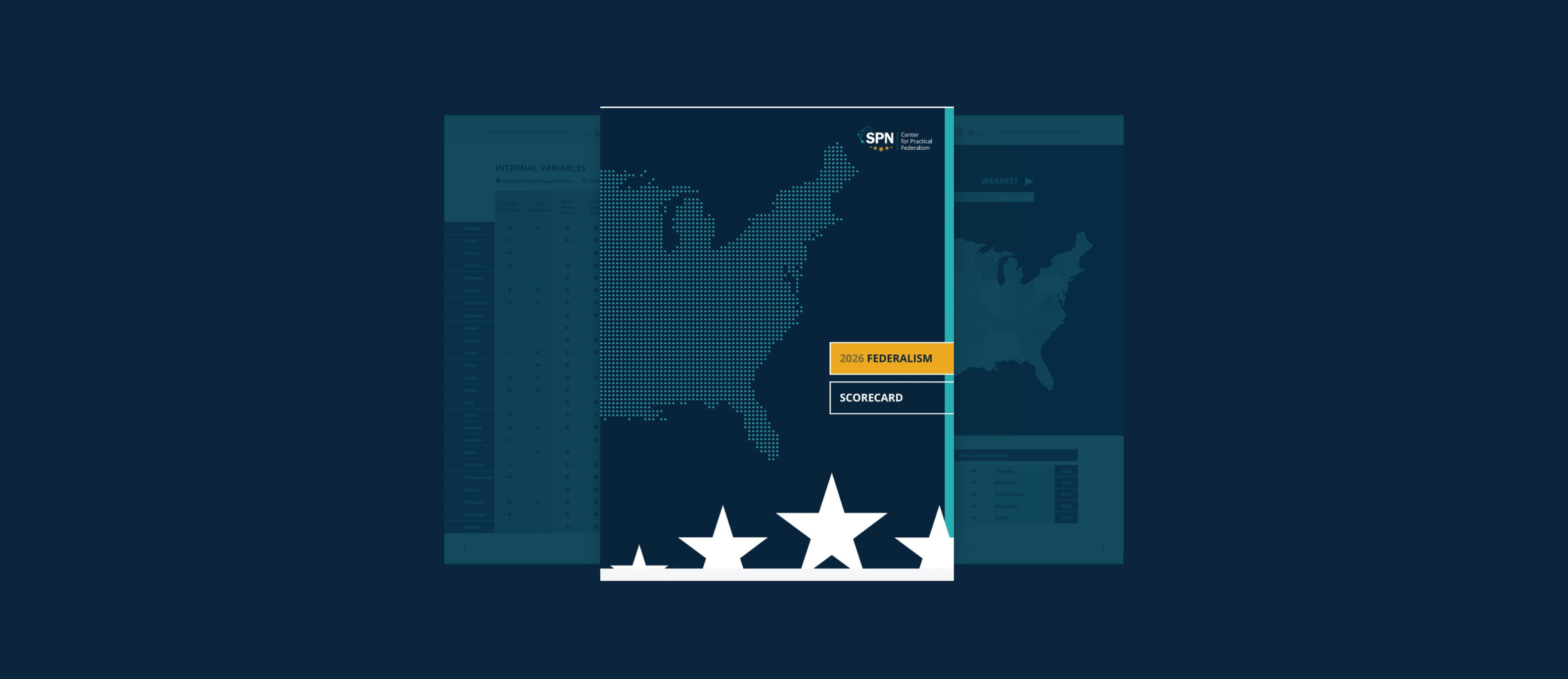
2026 Federalism Scorecard
See how all 50 states compare on the laws and practices that shape their vulnerability to federal influence.
The 2026 Federalism Scorecard is the Center for Practical Federalism’s fourth annual 50-state assessment of state vulnerability to federal influence. It looks at whether lawmakers and other elected state officials have the visibility, authority, and practical tools to oversee state agencies and understand how those agencies interact with federal agencies and federal funding.
A higher score means a state has more of the legal and institutional safeguards measured by the Scorecard. It is not a ranking of the “best” or “worst” states. Instead, it shows where states have stronger protections for state autonomy, legislative oversight, and representative self-government—and where opportunities for improvement remain.
Explore the Scores
2026 Federalism Scorecard at a Glance
| Rank | State | Score |
|---|---|---|
| 1 | Utah | 86.90 |
| 2 | Vermont | 56.70 |
| 3 | Tennessee | 53.95 |
| 4 | Idaho | 50.15 |
| 5 | Wisconsin | 44.80 |
| 6 | South Carolina | 42.45 |
| 7 | Kansas | 41.40 |
| 8 | Oregon | 34.60 |
| 9 | Oklahoma | 31.50 |
| 10 | Indiana | 30.50 |
| 11 | Florida | 28.55 |
| 12 | Connecticut | 27.65 |
| 13 | Delaware | 27.35 |
| 14 | North Dakota | 24.75 |
| 15 | New Hampshire | 21.60 |
| 16 | Ohio | 17.85 |
| 17 | Nebraska | 17.50 |
| 18 | Arkansas | 16.60 |
| 19 | Louisiana | 16.50 |
| 20 | Wyoming | 16.30 |
| 21 | Kentucky | 14.55 |
| 22 | West Virginia | 14.10 |
| 23 | Georgia | 13.50 |
| 24 | Arizona | 13.30 |
| 25 | North Carolina | 13.25 |
| 26 | South Dakota | 12.50 |
| 27 | New Jersey | 9.30 |
| 28 | Virginia | 7.70 |
| 29 | Texas | 6.70 |
| 30 | Colorado | 5.95 |
| 31 | Washington | 5.85 |
| 32 | Nevada | 5.65 |
| 33 | Maine | 5.15 |
| 34 | Minnesota | 5.00 |
| 35 | Missouri | 3.70 |
| 36 | Iowa | 2.70 |
| 37 | California | 2.65 |
| 38 | Rhode Island | 2.60 |
| 39 | Pennsylvania | 2.01 |
| 40 | New York | 0.60 |
| 41 | Alabama | 0.30 |
| 42 | Michigan | 0.10 |
| 43 | Hawaii | 0.10 |
| 44 | New Mexico | -3.55 |
| 45 | Illinois | -3.70 |
| 46 | Maryland | -7.00 |
| 47 | Montana | -14.00 |
| 48 | Massachusetts | -14.80 |
| 49 | Mississippi | -15.50 |
| 50 | Alaska | -27.70 |
A higher score indicates greater strength against federal agency pressure and influence.
Utah ranks first in the 2026 Federalism Scorecard with a score of 86.90, followed by Vermont, Tennessee, Idaho, and Wisconsin. At the other end of the index, Maryland, Montana, Massachusetts, Mississippi, and Alaska are the five states the Scorecard identifies as most vulnerable to federal agency pressure and influence.
The results reflect both changes in state policy and refinements to the Scorecard's methodology. The 2026 edition places greater emphasis on whether safeguards work in practice—not simply whether a law exists on the books.
What changed in the 2026 Federalism Scorecard
The 2026 Federalism Scorecard reflects important changes in both federal funding and state oversight. States are facing greater uncertainty about the costs and reliability of federal funding, making it more important to understand the full cost of federal grants and to plan for what happens if federal dollars are reduced, delayed, or discontinued.
States are also adopting new tools to give elected officials more oversight of government agencies. REINS-style laws, which require legislative review or approval of major agency regulations, expanded rapidly: by early 2026, 10 states had these protections. Louisiana adopted both a REINS-style law and a judicial non-deference law, while Alabama and Kansas also strengthened limits on judicial deference to state agencies.
The 2026 Scorecard also sets a higher bar for what counts as an effective safeguard. This year's methodology places greater emphasis on whether legislative oversight, federal-funding contingency plans, and federal grant cost-accounting requirements work in practice—not simply whether a law exists on the books. The Scorecard also no longer includes the Null and Void Statutes variable because the research did not find enough evidence that states were using those provisions as a meaningful protection against the loss of federal funds.

How the Federalism Scorecard Works
The Federalism Scorecard examines two groups of state laws and practices: internal safeguards and external safeguards. Internal safeguards measure how effectively elected officials oversee their own state executive agencies. External safeguards measure how states maintain oversight and authority when state agencies interact with federal agencies and federal funding.
Both matter because federal agencies often influence state policy through their state-agency counterparts. When lawmakers have strong powers of oversight, investigation, and review, they are better positioned to understand agency actions and respond when federal influence affects state decision-making. When those tools are weak, that influence can be harder to identify or address.
State Agency Influence
-
Every legislative committee can engage in some kind of oversight. Dedicated oversight committees, on the other hand, exist to hold investigatory hearings, report their findings, and make reform recommendations, where warranted, to the larger legislative body.
-
Some states have judicial precedent and practice that limit deference to agency interpretation, others have statutes restricting state court deference to agency interpretations, and a few have both.
-
Constraints on the ability of state agencies to lobby their own legislature are necessary to defend federalism because federal agencies can quietly influence state agency officials through a variety of means, in effect making them federal proxies in state capitals.
-
Some states have laws that subject regulations with estimated costs above a certain level to legislative review and approval.
-
While legislative review of regulations is a valuable and proper check on state agencies, this balance of power can be assisted by independent bodies tasked with ensuring that agencies are following state administrative procedures and otherwise complying with state laws.
-
When state agencies initiate some kind of action that a citizen believes is illegal or unconstitutional, it can be difficult for the citizen to get a hearing in court. Tennessee is the only state that currently guarantees the opportunity to seek injunctive relief for citizens harmed by state agency actions.
-
This variable captures whether a state’s legislature has established subpoena power. While subpoena authority is considered by the US Supreme Court to be an inherent state legislative power, some legislatures haven’t formally established it in a manner that facilitates oversight. They thereby diminish their capacity to investigate and intervene when their state agencies receive questionable directives and legal interpretations from federal authorities.
Federal Agency Influence
-
It is imperative that a state’s elected representatives maintain both visibility and authority over the commitments and unreimbursed costs that states take on when they accept a federal grant.
-
Requiring elected officials’ approval for federal grants ensures unelected bureaucrats are not the ones agreeing to a grant’s conditions and hidden costs.
-
A number of states require some form of elected-official oversight for federal grants but have exemptions for entities such as public universities, enabling them to lobby federal agencies for rules that conflict with the interests of the state’s citizens and taxpayers.
-
There is no guarantee that most federal grants will continue to flow to states, yet many states fail to maintain even rudimentary plans for minimizing harm and disruption in the event of a delay, reduction, or cessation of federal funds.
-
Federal money isn’t free; it generates unreimbursed costs, and increasingly federal agencies threaten discontinuation to compel compliance with directives that bear little connection to the stated intent of the funds. States that fully account for these costs are in a better position to judge whether accepting any particular grant is truly in the best interest of their citizens.
-
Federal agencies can exert substantial influence over state and local governments through guidance. Although federal guidance is not law and is not legally binding on regulated parties, state agencies often treat it as if it carries the weight of law. Worse yet, some federal guidance crosses a legal boundary from clarification of existing regulation into formulation of new rules that are not authorized by statute.
Because guidance is rarely examined by lawmakers or the public, it may lead to substantial alteration in state agency practices that contravene both law and the desires of citizens. Requiring a state agency to disclose federal guidance will shine a light on unlawful practices, enabling lawmakers to craft policies that best serve their communities
-
States are required to follow reporting guidelines for federal grants and have some visibility through websites such as USASpending.gov. This variable assesses individual states’ laws and practices around how they disclose receipt and expenditure of federal moneys, and in particular whether those practices yield transparency and public accessibility.
-
We focus on two significant State Implementation Plans (SIP): those tied to the Clean Air Act and to Medicaid administration. State agencies can change key elements of these SIPs without the agreement or knowledge of elected officials, and sometimes even with subsequent enforcement taken up by federal officials. States which require that changes to key SIPs be subjected to legislative scrutiny help guard against such secretive lawmaking.
-
Unelected state officials can influence federal policy in ways that circumvent the intentions of citizens as expressed through their elected representatives by spending millions lobbying federal agencies on all manner of legislation, spending, and rules governing the particulars of that spending.
-
The more dollars a state receives from federal agencies, the more vulnerable it is to agency demands. There are many reasons a state may receive an above-average percentage of its revenue from DC, and many of those reasons are beyond a state’s control. We incorporate this variable nonetheless, because it indicates a significant vulnerability to federal influence.
About the 2026 Research
The 2026 Federalism Scorecard was prepared by Tony Woodlief, Senior Fellow at the Center for Practical Federalism, and Tenille Martin, Research Associate at the Center. The research draws on state statutes and constitutions, legislative websites and records, state transparency systems, federal data, and other primary and secondary sources identified in the full report.